QA · Manual Testing · Defect Documentation

Indian Creek Cycles · QA Testing

Revisiting the Indian Creek Cycle Rentals capstone from a tester's perspective: structured test cases, exploratory sessions, documented defects, and regression tracking on the admin features.

type: personal project · app under test: www.indiancreekcycles.com · status: fixes verified · July 2026

The Problem

"It works" isn't the same as "it's been tested."

Indian Creek Cycle Rentals was originally built as a team capstone project, where the focus was shipping features. This project revisits the finished application from a tester's perspective: writing structured test cases, exploring the admin features the way a real user or administrator would, and documenting what actually breaks rather than what was assumed to work.

The scope now covers both the public-facing site and the custom admin functionality: homepage, navigation, bicycle listings and details, the reservation workflow, authentication, responsive design, accessibility, and error handling, alongside the dashboard, bike management, reservation management, accessories, reviews, and role-based permissions. That broader scope is what surfaced two accessibility defects that pure admin testing would have missed.

At a glance

  • 19 manual test cases, 21 with regression retests
  • 6 documented defects, all fixed & verified
  • 1 exploratory testing session
  • 1 regression cycle, 21/21 passing, 0 new regressions
  • Smoke, functional, negative, responsive, accessibility & visual testing

Approach

Plan, execute, document, retest.

Manual functional, negative, responsive, accessibility, and visual testing, plus exploratory testing, across Google Chrome and Safari, on macOS and Windows 11, desktop and mobile, with regression testing staged and ready once fixes land.

01

Test Plan

Defined scope, approach, environment, and success criteria before writing a single test case, so testing stayed focused on the admin features rather than re-testing the whole capstone app.

02

Test Cases

19 structured manual test cases spanning smoke, functional, negative, responsive, accessibility, visual, and regression testing (17 passed, 2 failed), each with steps, expected results, priority, and status.

03

Exploratory Testing

A free-form session across navigation, the reservation workflow, and the admin dashboard surfaced the first four defects; targeted accessibility testing at higher browser zoom and keyboard-only navigation found two more.

Bug Reports

Six defects, documented, fixed, and verified.

Each defect includes severity, steps to reproduce, expected vs. actual results, impact, and a suggested fix: the same structure a development team would need to triage and act on it. All six have since been fixed and passed regression testing.

MEDIUM Fixed & Verified

BUG-001: Dashboard Overcounts Active Reservations

The dashboard reports 19 reservations as "active right now," but the count includes reservations whose end dates have already passed.

MEDIUM Fixed & Verified

BUG-002: Expired Pending Reservations Never Resolve

Reservations stay in Pending status indefinitely after their period ends. There's no expiration policy to move them to a final status.

LOW Fixed & Verified

BUG-003: Ride Guide Omits the Cancellation Policy

Customers aren't told how long a reservation stays pending or when an unpaid reservation gets auto-cancelled.

HIGH Fixed & Verified

BUG-004: Dashboard Revenue Doesn't Match Its Own Breakdown

The dashboard revenue card shows $782.00; the Revenue Breakdown page, on the same data, totals $863.00. The dashboard silently excludes rental add-on revenue.

MEDIUM Fixed & Verified

BUG-005: Browser Zoom Breaks Navigation

The site holds up through 150% browser zoom, but at 175% the nav bar disappears, the hamburger menu stops responding, and the logo no longer links home.

MEDIUM Fixed & Verified

BUG-006: Keyboard Navigation Requires Mouse Interaction

Tab/Shift+Tab/Enter work fine within a section, but moving from the header navigation into page content requires a mouse click before keyboard navigation resumes.

BUG-004 in detail

This was the highest-severity find: two pages reporting two different totals from the same underlying data, which is exactly the kind of bug that erodes trust in a dashboard. The Revenue Breakdown page correctly sums Bike Rentals ($737), Rental Add-Ons ($81), and Merchandise ($45) to $863, but the dashboard's revenue card leaves rental add-ons out of its total entirely.
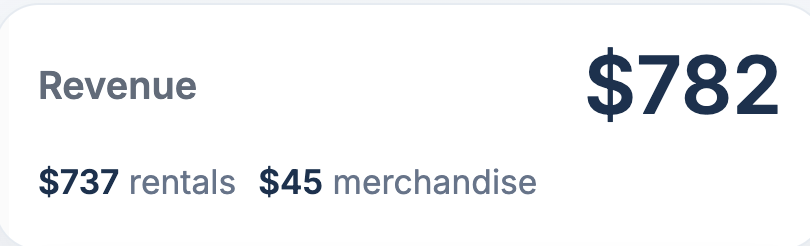

Admin dashboard revenue summary card showing $782.00 total revenue, missing rental add-on revenue.
Revenue breakdown page showing Bike Rentals $737, Rental Add-Ons $81, Merchandise $45, for a correct total of $863.

BUG-005 in detail

Found while testing accessibility at increased browser zoom, a real scenario for low-vision users. Navigation degrades gracefully up to 150% zoom, but crosses a breaking point at 175%: the nav bar disappears entirely, the hamburger menu stops opening, and clicking the logo no longer returns users to the homepage.

Website navigation bar broken and missing at 175% browser zoom.

BUG-006 in detail

Documented as a screen recording rather than a screenshot, since the bug is about motion: where keyboard focus goes (or doesn't) as you tab from the header into the page.

▶ Watch the recording

Bug Fixes

From bug report to verified fix.

Each defect was handed off with a suggested fix, then closed out with a real code change and a regression pass to confirm it. Here's the BUG-004 fix, the dashboard revenue mismatch, straight from the commit diff:

+    rental_addon_revenue = Decimal("0.00")
+    # BUG-004: rental add-ons are revenue too, so include them in the dashboard total.
+    for item in ReservationAccessory.objects.filter(
+        fulfillment_type="rental",
+        reservation__status__in=["paid", "active", "completed"],
+    ):
+        rental_addon_revenue += item.get_total()

One line explaining why the fix exists, right next to the code that makes it, is a small habit that makes a defect easy to verify later. All six fixes follow this same pattern.

Regression Testing

All six defects closed, no new regressions.

Each defect was mapped to the test case that would confirm it was actually resolved: TC-002 for BUG-001, TC-007 for BUG-002, TC-010 for BUG-003, TC-019 for BUG-004, TC-020 for BUG-005, and TC-021 for BUG-006. Regression Cycle 1 has been completed: all 21 test cases pass, all six defects are closed and verified, and no new issues were introduced by the fixes.

Project Files

What's in the repo.

File Description
README.mdProject overview, scope, and testing types
test-plan/test-plan.mdScope, approach, environment, and success criteria
test-cases/Manual-Test-Cases.xlsx19 structured manual test cases
bug-reports/BUG-001 through BUG-006Individual defect reports with repro steps and severity
bug-reports/Bug-Log.xlsxDefect tracker: status, severity, and fix verification
bug-fixes/Developer-Fix-Summary.mdWhat changed for each fix, and where
bug-fixes/Bug-Fix-Code-Comparison.mdBefore/after code diffs for all six fixes
evidence/Screenshots and a screen recording supporting each bug and test case
exploratory-testing/Session-01.mdExploratory session charter and findings
regression-testing/RegressionTestingResults.mdRegression Cycle 1 results: 21/21 passing, all defects closed

What I Learned

Testing your own project is its own skill.

Testing an application I'd already built required deliberately setting aside what I knew was "supposed" to happen and testing what actually does. The dashboard revenue mismatch is a good example: a bug that's easy to miss when you built the feature, but jumps out the moment you compare two numbers that are supposed to agree. Structuring the bug reports with severity, impact, and a suggested fix, rather than just "this is broken," is the same discipline I want to bring into a QA role: making defects easy for a development team to prioritize and act on, not just easy to find. Expanding testing to the public-facing site also surfaced something functional testing alone wouldn't have: two accessibility defects, at higher browser zoom and with keyboard-only navigation, that only show up when you deliberately test outside the "default" way of using a site. Seeing all six through to a fixed, regression-tested, closed status was the part that made the process feel complete: a bug report only really matters once it's verified fixed, not just filed.